


Your Professional Blown Film Extrusion Line Supplier
Jwell, a vice president unit of the China Plastics Machinery Industry Association, is a leading manufacturer specializing in plastic extrusion equipment and complete sets of chemical fiber spinning machinery. The company's main product lines include: various types of cast film, sheet, and board production lines; different kinds of plastic pipe and profile production lines; blowing molding machines; chemical fiber spinning equipment; as well as plastic recycling and compounding granulation systems. Additionally, Jwell supplies key accessories such as screw barrels, extrusion flat die heads, screen changers, and rollers.
Strong Manufacturing Capabilities
The company comprises 26 specialized subsidiaries, nine large-scale metal processing plants, and three heat treatment and nitriding facilities.
Independent Intellectual Property Rights
Jwell has established an independent intellectual property system and holds nearly 400 authorized patents.
Professional and Experienced Team
Our dedicated team collaborates with clients to identify personnel, resources, and process documentation necessary to support maintenance operations effectively.
High Production Capacity and Global Reach
Jwell produces approximately 3,000 sets of extrusion lines annually, which are exported to over 120 countries worldwide.


Parameter
|
Model |
Max.layflat film width mm |
Products thickness mm |
Lay structure mm |
Total power KW |
Max.capacity. KW/H |
|
JBF-1600-3/5X |
1600 |
0.03-0.12 |
A/B/C & A/B/C/D/E |
250-300 |
300-400 |
|
JBF-1800-3/5X |
1800 |
0.03-0.12 |
A/B/C & A/B/C/D/E |
300-350 |
400-500 |
|
JBF-2100-3/5X |
2100 |
0.03-0.12 |
A/B/C & A/B/C/D/E |
250-300 |
500-600 |
|
JBF-3000-5X |
3000 |
0.05-0.15 |
A/B/C/D/E |
350-450 |
600-700 |
Video
Types of Blown Film Extrusion Line
The blown film extrusion lines produced by our company mainly include the following types:
7/9-Layer Greentec Blown Film Line
7/9-layer co-extrusion high-barrier film line uses specially designed screw barrels and dies, which can process resin materials such as PA, EVOH, etc., so that the film products produced have excellent gas barrier properties and can effectively block oxygen, The penetration of nitrogen, carbon dioxide and water vapor meets the various needs of different users for freshness, air tightness, anti-corrosion and moisture-proofing.
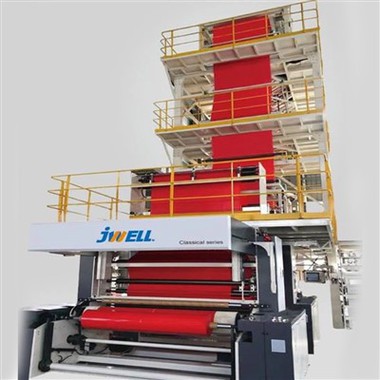
3/5-Layer Classical Extrusion Blown Film Line
3/5-layer Classical Blown Film Extrusion Line can be used to produce self-adhesive electronic protective film, FFS plastic particle heavy packaging film, composite substrate film, express bag film, etc., cotton packaging film, pasture silage film, and container inner wrapping film.
Advantages of Blown Film Extrusion Line
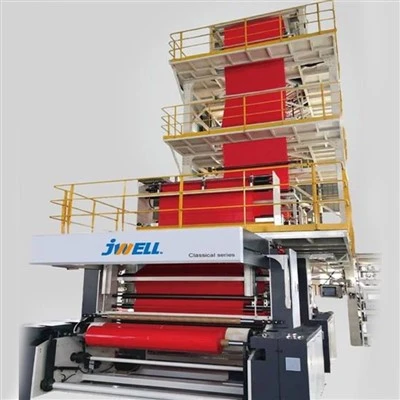
Balanced mechanical properties
Blown film extrusion ensures that the film has balanced mechanical properties such as tensile strength, tear resistance, and puncture resistance. This balance is achieved because the film is stretched in both the machine direction (MD) and transverse direction (TD) during processing. Unlike simple extruded films, which may have uneven properties, blown film has more uniform properties, making it suitable for a wide range of applications.
Increased tensile strength
The stretching process during blown film extrusion aligns the polymer molecules, which increases tensile strength. This makes the film more durable and able to withstand pressure, which is particularly important for applications such as stretch film, packaging, and industrial uses.
Flexibility
Due to the molecular orientation achieved during the extrusion process, blown film is highly flexible. This flexibility allows the film to conform to a variety of shapes and surfaces, making it ideal for packaging applications that require a tight wrap.
Robustness
The combination of balanced mechanical properties and enhanced tensile strength results in a strong, durable film that can withstand harsh operating and environmental conditions. This robustness is critical for applications such as agricultural films, building films, and heavy-duty packaging.
Cost-effectiveness
Blown film extrusion is a cost-effective way to produce high-quality films. The process achieves high production rates and minimizes material waste, which reduces overall manufacturing costs.
Versatility
The blown film process can produce films of varying thickness, width, and properties, making it suitable for a wide range of applications. It can also accommodate different types of polymers, including polyethylene (PE), polypropylene (PP), and others, further increasing its versatility.
Uniform Thickness
The bubble formation and cooling process during blown film extrusion ensures that the film thickness is uniform and consistent. This uniformity is critical for applications that require precise dimensions, such as medical packaging and food packaging.
Better Barrier Properties
Blown films can be engineered to provide excellent barrier properties against moisture, gases, and UV rays. This is particularly beneficial for food packaging, which is critical to maintaining product freshness and shelf life.
Applications of Blown Film Extrusion Line

Medical Packaging Applications
In the medical sector, packaging demands are stringent due to requirements for sterility and protection. Blown film products are ideal for medical packaging films, offering exceptional barrier properties against contaminants. Applications include packaging for medical devices, pharmaceuticals, and sterile instruments.
Industrial Packaging Applications
Industrial packaging often requires materials that can withstand heavy-duty use and harsh environments. Blown film extrusion produces strong and durable films suitable for industrial packaging solutions such as drum liners, shrink films, and heavy-duty bags.
Food and Beverage Packaging Applications
Food-grade plastic sheeting produced through blown film extrusion plays a crucial role in the food and beverage industry. These films provide excellent moisture barriers and preserve the freshness of food products. Applications include shrink wrap for perishable goods, bags on rolls for produce, and specialty films for Form, Fill, and Seal (FF&S) machines.
Types of Raw Materials That Can Be Processed by Blown Film Extrusion Lines
Polyethylene (PE): This is the most commonly used material in blown film extrusion lines. It is a versatile material that can be used to produce a wide range of films, including high-density polyethylene (HDPE) and low-density polyethylene (LDPE).
HDPE is used to produce stiff films that are suitable for packaging heavy items. LDPE is used to produce flexible films that are ideal for wrapping around objects. LLDPE is a blend of HDPE and LDPE and is used to produce films that have the properties of both materials.
Polypropylene (PP): PP is a thermoplastic polymer that is made from propylene monomer. It is stiffer and more heat-resistant than PE, This material is often used to produce films with high strength and stiffness, as well as industries that require films with good heat resistance, such as the food industry.
Polyvinyl chloride (PVC): This material is often used to produce films that require high clarity and good resistance to chemicals.
Ethylene vinyl acetate (EVA): This material is often used to produce films that require good adhesion and elasticity.
Nylon (PA): This material is often used to produce films that require high strength and durability, as well as films that require good barrier properties. PA films are strong, durable, and resistant to punctures and tears. They are used in the food industry to package products that require high levels of protection, such as meat and cheese.
Polystyrene (PS): This material is often used to produce films that require high clarity and good stiffness.
Steps to Setting Up a Blown Film Extrusion Line
Install the die head
Start by installing the die head on the extruder. The die head shapes the melted plastic into a tubular structure. Finally, make sure the die head is aligned and secure.
Adjust the air ring
The air ring is responsible for cooling the plastic that is passing through the die head. To achieve the quality and thickness you desire, adjust the airflow and temperature.
Calibrate the temperature and speed controls
Your machine's speed and temperature controls make sure that the plastic is heated and fed through the die at the proper rate. To ensure that the film is created with consistent quality, calibration is crucial. Set the temperature and speed controls to the levels that are suggested for your material to start, and then adjust as necessary to get the right results.
Test the blown film machine
It's time to test the machine once you've placed the die head, adjusted the air ring, and calibrated the temperature and speed controls. Check the film for the desired thickness, width, and quality by running a trial of the material.
Packaging and Shipping
|
Packaging |
In wooden cases, wooden splints, wrap film and other specialized packaging film, to ensure that the machine impact damage in the long time of land and sea transport, thus reaching the customer factory intact. |
|
Shipping |
Shipping by sea, by air, by express are acceptable. According to your requirements. |
Our Factory
Asia's largest and fastest growing professional plastic machinery equipment manufacturer , Jwell Machinery Co., LTD., founded in 1997. until now, Jwell factory covers more than 700,000 square meters and has 8 production bases and 26 professional extrusion companies in the world. They are located in Shanghai, Zhejiang provinces, Jiangsu provinces, Guangdong Province and Thailand.
Certificate


FAQ
As one of the most professional blown film extrusion line manufacturers and suppliers in China, we're featured by quality products and competitive price. Please rest assured to buy blown film extrusion line made in China here from our factory. Contact us for quotation.
cold extrusion line, 5 layer blown film line, petrochemical plastic Pelletizer