


Your Professional Compounding Equipment Supplier
Jwell, a vice president unit of the China Plastics Machinery Industry Association, is a leading manufacturer specializing in plastic extrusion equipment and complete sets of chemical fiber spinning machinery. The company's main product lines include: various types of cast film, sheet, and board production lines; different kinds of plastic pipe and profile production lines; blowing molding machines; chemical fiber spinning equipment; as well as plastic recycling and compounding granulation systems. Additionally, Jwell supplies key accessories such as screw barrels, extrusion flat die heads, screen changers, and rollers.
Strong Manufacturing Capabilities
The company comprises 26 specialized subsidiaries, nine large-scale metal processing plants, and three heat treatment and nitriding facilities.
Independent Intellectual Property Rights
Jwell has established an independent intellectual property system and holds nearly 400 authorized patents.
Professional and Experienced Team
Our dedicated team collaborates with clients to identify personnel, resources, and process documentation necessary to support maintenance operations effectively.
High Production Capacity and Global Reach
Jwell produces approximately 3,000 sets of extrusion lines annually, which are exported to over 120 countries worldwide.




Parameter
|
Model |
Diameter mm |
L/D |
Screw speed rpm/min |
Motor power KW |
Torque per shaft N.m |
Specific torque T/A3 |
Capacity range kg/hr |
|
CJWA35 |
35.6 |
24~68 |
600 |
18.5 |
149 |
6 |
50~100 |
|
CJWA40 |
41.1 |
24~68 |
600 |
30 |
226 |
6 |
75~150 |
|
CJWA52 |
51.4 |
24~68 |
600 |
55 |
437 |
6 |
140~280 |
|
CJWA65 |
62.4 |
24~68 |
600 |
110 |
773 |
6 |
280~560 |
|
CJWA75 |
71.0 |
24~68 |
600 |
160 |
1188 |
6 |
400~800 |
|
CJWA85 |
81.0 |
24~68 |
600 |
220 |
1714 |
6 |
550~1100 |
|
CJWA95 |
93.0 |
24~68 |
600 |
350 |
2610 |
6 |
880~1760 |
|
CJWA110 |
108.0 |
24~68 |
500 |
450 |
4010 |
6 |
1100~2200 |
|
CJWA120 |
120.0 |
24~68 |
500 |
600 |
5500 |
6 |
1500~3000 |
|
CJWA135 |
132.0 |
24~68 |
400 |
650 |
7321 |
6 |
1600-3200 |
|
Note: The specifications are subject to change without prior notice. |
|||||||
Types of Compounding Equipment

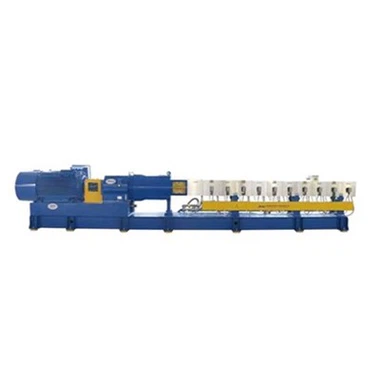
Parallel Tri-Screw Co Rotating Extruder
Parallel Tri-Screw Co-Rotating Extruder is a type of extruder that utilizes three screws rotating in the same direction, within a barrel, to process materials. This design enhances mixing and dispersion capabilities, making it suitable for applications requiring high-quality mixing of materials, such as masterbatch production and other applications with high filler content.
Engineering Plastics Compounding Extruder Machine
Our engineering plastics compounding machine can be used to mix, plasticize and colore modification of engineering plastics, modified plastics, color masterbatch and other polymers.
Bio-Degradable Plastics Underwater Pelletizer
An underwater pelletizer is a machine that produces uniform plastic pellets by cutting molten plastic within a chamber of circulating water. For biodegradable plastics, this technology offers a way to process these materials into a usable form while maintaining their inherent characteristics and promoting sustainability.
Competitive advantage
Efficient mixing and dispersion
Compounding equipment can provide excellent mixing and dispersion capabilities, especially in the polymer/filler mixing process, through the interaction between the screws to achieve a uniform mixing effect.
01
Flexibility and modular design
Compounding equipment usually has flexible configuration options and can be customized according to specific application needs to optimize the production process.
02
Reduced material waste
Due to its efficient mixing and uniform distribution, twin screw compounding extruder can reduce material waste and performs particularly well when processing high viscosity or high moisture content materials.
03
High-quality product output
Compounding equipment is able to operate at lower melt temperatures, thereby maintaining the bright color of the product and very stable product quality.
04
Strong adaptability
The compounding equipment can handle a variety of materials, including high-humidity and sticky materials, which makes it widely used in industries such as food, pharmaceuticals, and polymers.
05
dshow machinery co.,ltd
Polymer compounding applications
Use cases here include modifying blends, fiber enhancement, and alloying.
Reactive extrusion
Applications include modifying polymers by melting, blending, and shaping.
Rubber and plastic processing
Applications can include recycling or manufacturing plastic and rubber products from raw rubber and plastics.

Pay Attention To Compounding Equipment Safety Procedures
Check Machine And Lubricate
Before starting the compounding extruder, check whether there is any foreign matter in the barrel, up and down the hopper, and inside, check whether the fastening bolts of each part are loose, whether the safety cover is firm, whether the position of each button switch is correct, and then lubricate each part. Add enough lubricating oil and do a good job of cleaning and sanitizing the equipment.
Temperature Control Testing
Before starting the machine, check whether the temperature control is sensitive, whether the instrument is out of order, and whether the cooling water circuit is smooth. Usually, methods such as thermometers and cooling water are used for detection.
Heating Step
Follow the compounding extruder operating procedures to heat the screw, barrel, and die head. Once reaching the set temperature, maintain warmth for about 10 minutes before starting the machine to ensure temperature stability in all parts.
Notify Staff Before Starting
Alert nearby staff when preparing to start the machine. Before starting, ensure all connecting screws and bolts of the die are tightened while it’s hot. Operators must avoid standing in front of the die before material extrusion to prevent injury from potential bolt or screw breakage.
Low-Speed Starting Motor
Start the motor for driving the screw rotation at low speed, and check whether the pointer of the working ammeter of the main motor swings normally.
Trial Run
The test run of the screw should not exceed 30 minutes. Once everything is normal, connect the die head and pelletizing equipment. Install the die head bolts and apply molybdenum disulfide or silicone oil to facilitate disassembly.
Initial Input
In the initial stage of feeding production, the screw should use the lowest working speed, and the feeding should be less and uniform. Check whether the pointer of the working ammeter of the motor used to drive the screw rotation changes at any time.
Temperature Checks During Production
During regular production, monitor bearing temperatures on the extruder. Use the back of your finger to touch motor and bearing parts for temperature checks gently. Avoid touching rotating parts during equipment operation.
Precautions For Disassembly And Assembly
When dismantling and installing the screw and mold, do not directly hit the parts with a heavy hammer, if necessary, pad hardwood and then tap to disassemble or install.
Clean Up Residue
Clean residual material from the screw, barrel, and mold with bamboo or copper knives, brushes, or specialized water and air washing equipment. Avoid using steel knives or fire. Alternatively, use special screw cleaning materials for cleaning without disassembly.
Packaging and Shipping
|
Packaging |
In wooden cases, wooden splints, wrap film and other specialized packaging film, to ensure that the machine impact damage in the long time of land and sea transport, thus reaching the customer factory intact. |
|
Shipping |
Shipping by sea, by air, by express are acceptable. According to your requirements. |
Our Factory
Asia's largest and fastest growing professional plastic machinery equipment manufacturer , Jwell Machinery Co., LTD., founded in 1997. until now, Jwell factory covers more than 700,000 square meters and has 8 production bases and 26 professional extrusion companies in the world. They are located in Shanghai, Zhejiang provinces, Jiangsu provinces, Guangdong Province and Thailand.
Certificate


FAQ
As one of the most professional compounding equipment manufacturers and suppliers in China, we're featured by quality products and competitive price. Please rest assured to buy compounding equipment made in China here from our factory. Contact us for quotation.
strand pelletizer, plastic pelletizing production line, hollow board extrusion line