


Cast Film Vs Blown Film
Jan 23, 2026
Leave a message
Cast film vs blown film: who is the "king" of the film industry? An In-Depth Showdown Between Process and Performance
In the vast world of plastic films, there are two major "schools" that have long been competing with each other:blown film and cast film.
Many newcomers to the industry,and even some experienced buyers, are often confused by these two terms:
"Why can CPP only be produced by cast extrusion rather than blown extrusion?"
"Why are most wrapping films cast films, while shopping bags are mainly blown films?"
"Which process is actually better?"
In this article, In this article, we take a professional perspective and examine these two processes in depth-from processing principles and performance differences to application fields and selection guidelines-to help you determine which option is most suitable for your needs.
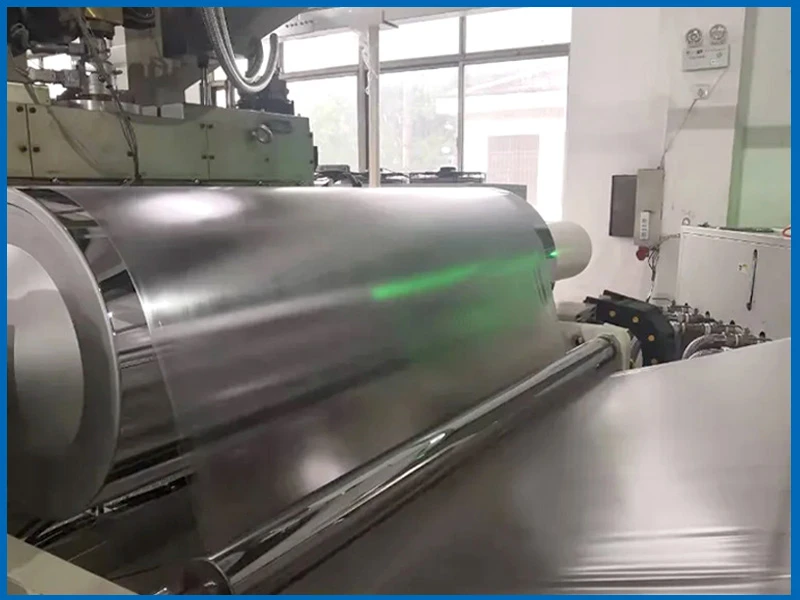
Chapter 1: The Craft Reveal - How is it "born"?
To evaluate film performance, it is essential to first understand how it is manufactured. The core differences between cast film and blown film lie in forming methods and cooling mechanisms.
1. Blown Film: Like blowing bubbles
The blown film process is similar to inflating a giant balloon.
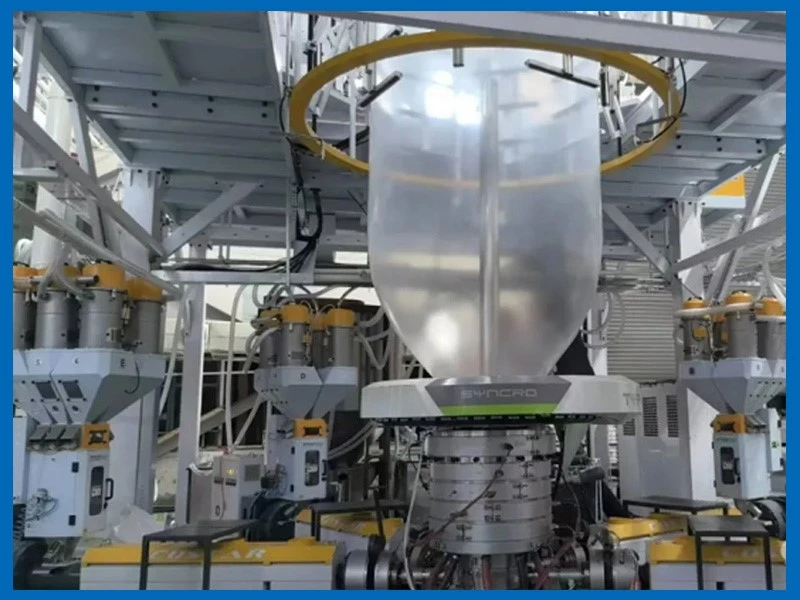
• Process: Plastic pellets are melted and extruded through a ring-shaped die to form a tube. Compressed air is blown into the tube, inflating it into a large cylindrical bubble.
• Cooling: The film is cooled by surrounding air using a wind ring.
• Haul-off: he bubble rises upward, is collapsed by a collapsing frame, and finally wound into rolls.
[Keywords]: ring die; air cooling; biaxial stretching (machine direction + transverse direction).
2. Cast Film: Flows like a waterfall
The cast film process resembles a waterfall flowing downward.
• Process: The molten polymer exits a flat T-die (slit die) and flows downward like a curtain.
• Cooling: The melt comes into immediate contact with a large, rotating chill roll, where it is rapidly cooled and solidified by the low-temperature metal surface.
• Haul-off: The cooled film is trimmed, stretched in the machine direction, and finally wound into rolls.
[Keywords]: T-die; chill-roll quenching; predominantly uniaxial stretching.
Chapter 2: Performance Showdown - How Different Are the Finished Films?
Due to their different processing conditions, cast film and blown film exhibit distinctly different material properties. They can be compared across the following key aspects.
1. Optical properties (transparency and gloss)
• Winner: Cast film
Principle: Cast film is rapidly quenched by chill rolls, which significantly suppresses polymer crystallization and results in fine crystalline structures.
Performance: Excellent transparency, low haze, and high gloss. CPP cast film appears crystal clear.
• Blown film:
Air cooling is relatively slow, allowing more time for crystallization and the formation of larger crystalline structures, which increases light scattering.
Performance: Higher haze and moderate transparency, although advanced water-cooled blown film technologies have improved optical performance in recent years.
2. Mechanical Strength (Tensile & Tear Resistance)
• Winner: Blown Film (More Balanced Properties)
Principle: During blown film production, the film is stretched in both the machine direction and the transverse direction.
Performance: Strength is relatively balanced in both directions, with good toughness and high puncture resistance. This is why blown film is widely used for supermarket shopping bags, as it is less likely to tear when carrying heavy loads.
• Cast film (directional weakness)
Principle: Stretching occurs mainly in the machine direction, with minimal transverse orientation.
Performance: The molecular orientation is highly directional. While tensile strength in the machine direction is acceptable, transverse tear resistance is poor. Once a small notch forms, the film tends to tear straight across (similar to adhesive tape).
3. Thickness uniformity
• Winner: Cast Film
Data: Thickness tolerance can typically be controlled within ±1.5% to 3%.
Advantages: Excellent flatness, making it ideal for high-speed printing and precision coating.
• Blown film
Data: Thickness tolerance is usually around ±5% to 10%, even with rotating dies.
Disadvantages: Uneven thickness may lead to pronounced thickness bands during winding, negatively affecting subsequent lamination quality.
4. Barrier
Slight Advantage: Blown Film
Blown film is more suitable for incorporating high-barrier materials such as PA and EVOH through multilayer co-extrusion (e.g., 5-, 7-, or 9-layer structures). The equipment investment is relatively lower, and structural design is more flexible.
Chapter 3: Who Rules Which turf?(Application Fields)
Based on their performance characteristics, cast film and blown film dominate different application areas.
1. Typical Applications of Cast Film
• CPP (Cast Polypropylene): Inner heat-sealing layers for food packaging (e.g., biscuit and bread bags), requiring high transparency and good stiffness.
• Stretch film: Used for pallet wrapping, benefiting from the high production speed of cast lines (up to 500 m/min or more).
• Hygiene products: Diaper liners and sanitary product packaging, where softness and comfort (e.g., CPE) are critical.
• Aluminized substrates: Applications with extremely high flatness requirements, where cast film is the preferred choice.
2. Typical Applications of Blown Film
• General packaging: Shopping bags, T-shirt bags, and garbage bags (mainly PE), requiring toughness and low cost.
• Agricultural films: Mulch films and greenhouse films, where blown film can easily achieve ultra-wide widths.
• Heavy-duty packaging: Fertilizer bags and rice bags (FFS), requiring high impact and puncture resistance.
• Heat-shrink films: Utilizing biaxial orientation memory to shrink tightly around products when heated.
Chapter 4: Selection Guide and Common Pitfalls
When developing a new packaging solution, should you choose cast film or blown film? Consider the following factors.
1. Appearance vs. Durability
• If the product is display-oriented (e.g., flowers, premium textiles, transparent window packaging) and requires high clarity, choose cast film.
• If the product is heavy, rigid, or sharp-edged (e.g., frozen meat, hardware), and puncture resistance is critical, choose blown film.
2. Downstream Processing Requirements
• High-speed printing or coating: The superior thickness uniformity of cast film significantly improves yield and process stability.
• IBag making: Both films are suitable for simple heat-sealed bags; however, for complex bag structures, the risk of transverse tearing in cast film must be carefully evaluated.
3. Cost considerations
• Cast film: Higher equipment investment and energy consumption, but high output and efficiency, suitable for large-volume production.
• Blown film: Lower equipment threshold and greater flexibility in specifications, suitable for small- to medium-volume, multi-product production.
Summary
• There is no absolute "better" film-only the one that is more suitable for a given application.
• Cast film is a "gentleman": refined, flat, highly transparent, and efficient, but relatively delicate.
• Blown film is a hardworking "tough guy": strong, durable, versatile, but slightly less refined in appearance.
• By understanding their respective characteristics, you can make informed packaging design decisions that achieve both cost efficiency and practical usability.