


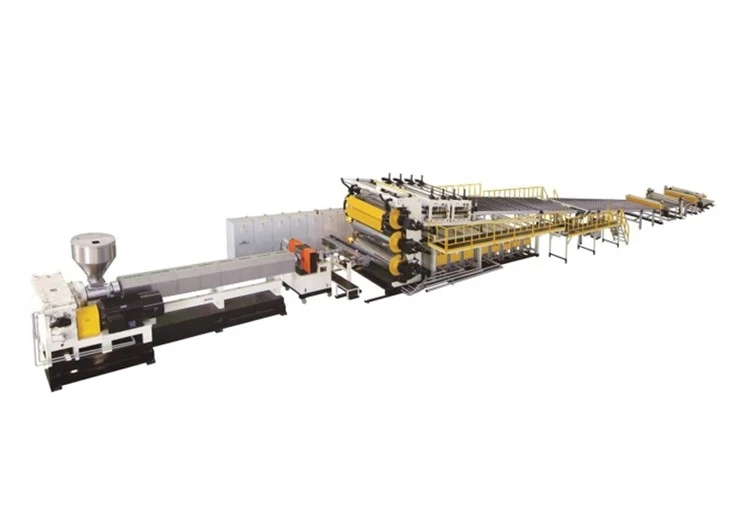
Quality inspection is a crucial step in the manufacturing process of products from an ABS sheet extrusion line. As a trusted supplier of Abs Hdpe Pp Sheet Extrusion Line, Pvc Asa Waved Sheet Production Line, and Hips/gpps/pp/pe/eva/abs Sheet Extrusion Line, we understand the significance of ensuring the high - quality of the ABS sheets produced. In this blog, we will explore various quality inspection methods for the products of an ABS sheet extrusion line.
Visual Inspection
Visual inspection is the most basic yet effective method for quality control. It involves a detailed examination of the ABS sheets with the naked eye or with the help of magnifying tools. Inspectors look for surface defects such as scratches, cracks, bubbles, and foreign particles.
Scratches on the surface of ABS sheets can affect their aesthetic appeal and, in some cases, their mechanical properties. Minor scratches might be acceptable for less - critical applications, but deep scratches can compromise the integrity of the sheet. Cracks are even more serious, as they can lead to the failure of the sheet under stress.
Bubbles trapped within the sheet during the extrusion process can weaken the material. They are usually caused by improper melting of the ABS resin, moisture in the raw material, or issues with the extrusion temperature and pressure. Foreign particles, such as dust or small pieces of metal, can also be detected through visual inspection. These particles can not only damage the appearance of the sheet but also cause stress concentrations, which may lead to premature failure.
Dimensional Inspection
Accurate dimensions are essential for ABS sheets, especially when they are used in applications that require precise fitting. Dimensional inspection typically includes measuring the thickness, width, and length of the sheets.
Thickness is a critical parameter, as it directly affects the mechanical properties of the ABS sheet. Variations in thickness can lead to uneven stress distribution, which may cause the sheet to warp or break under load. A thickness gauge is commonly used to measure the thickness at multiple points across the sheet to ensure uniformity.
The width and length of the sheets should also be within the specified tolerances. Deviations from the standard dimensions can cause problems during installation or assembly. Measuring tools such as calipers and rulers are used to check these dimensions.
Physical Property Testing
Tensile Strength Testing
Tensile strength is a measure of the maximum stress that a material can withstand while being stretched or pulled before breaking. For ABS sheets, high tensile strength is often required, especially in applications where the sheets are subjected to pulling forces.
To perform a tensile strength test, a sample of the ABS sheet is cut into a specific shape, usually a dumbbell shape, according to the relevant standards. The sample is then placed in a tensile testing machine, which applies a gradually increasing force until the sample breaks. The machine records the maximum force applied and calculates the tensile strength of the sample.
Impact Resistance Testing
Impact resistance is another important physical property of ABS sheets. It measures the ability of the sheet to withstand sudden impacts without cracking or breaking. This property is crucial in applications where the sheets may be exposed to accidental impacts, such as in automotive interiors or protective covers.
There are several methods for testing impact resistance, including the Izod and Charpy impact tests. In the Izod test, a notched sample of the ABS sheet is clamped vertically, and a pendulum is released to strike the sample at the notch. The energy absorbed by the sample during the impact is measured, which indicates its impact resistance. The Charpy test is similar, but the sample is supported horizontally, and the pendulum strikes the center of the sample.

Chemical Analysis
Chemical analysis is used to determine the composition of the ABS sheets and to ensure that they meet the required chemical specifications. This is important because the chemical composition of ABS can affect its physical and mechanical properties, as well as its resistance to chemicals and environmental factors.
Fourier - Transform Infrared Spectroscopy (FTIR)
FTIR is a widely used technique for chemical analysis. It works by measuring the absorption of infrared light by the ABS sheet. Different chemical bonds in the ABS polymer absorb infrared light at specific wavelengths, producing a unique infrared spectrum. By comparing the spectrum of the sample with a reference spectrum, the presence and concentration of different chemical groups in the ABS sheet can be determined.
Differential Scanning Calorimetry (DSC)
DSC is used to study the thermal properties of the ABS sheets, such as the melting point, glass transition temperature, and crystallization behavior. These properties are closely related to the chemical structure and molecular arrangement of the ABS polymer. By analyzing the DSC curve of the sample, information about the quality and stability of the ABS sheet can be obtained.
Surface Roughness Measurement
The surface roughness of ABS sheets can affect their appearance, friction coefficient, and adhesion properties. For example, in applications where the sheets need to be painted or bonded to other materials, a smooth surface is usually required.
Surface roughness can be measured using a surface profilometer. This instrument scans the surface of the ABS sheet and records the height variations of the surface profile. The roughness parameters, such as Ra (average roughness) and Rz (maximum height of the profile), are then calculated based on the measured data.
Environmental Testing
ABS sheets may be exposed to various environmental conditions during their service life, such as temperature, humidity, sunlight, and chemicals. Environmental testing is used to evaluate the performance of the sheets under these conditions.
Temperature and Humidity Testing
Temperature and humidity can have a significant impact on the physical and mechanical properties of ABS sheets. High temperatures can cause the sheets to soften and deform, while high humidity can lead to moisture absorption, which may affect the adhesion and mechanical strength of the sheets.
In temperature and humidity testing, samples of the ABS sheets are placed in a climate chamber, where the temperature and humidity are controlled according to the test requirements. The samples are then monitored for changes in dimensions, mechanical properties, and appearance over a certain period of time.
Weathering Testing
Weathering testing is used to simulate the long - term effects of sunlight, rain, and other environmental factors on the ABS sheets. There are two main types of weathering tests: natural weathering and accelerated weathering.
In natural weathering, the samples are exposed to the natural environment for a long period of time, usually several months or even years. This method provides the most realistic assessment of the weathering performance of the ABS sheets, but it is time - consuming. Accelerated weathering, on the other hand, uses artificial light sources and environmental chambers to simulate the weathering process in a shorter time.
Conclusion
In conclusion, quality inspection of products from an ABS sheet extrusion line is a comprehensive process that involves multiple methods. Visual inspection, dimensional inspection, physical property testing, chemical analysis, surface roughness measurement, and environmental testing are all important steps to ensure the high - quality of the ABS sheets.
As a leading supplier of ABS sheet extrusion lines, we are committed to providing our customers with high - quality equipment and reliable technical support. Our extrusion lines are designed to produce ABS sheets with excellent quality, and we also offer a range of quality inspection services to help our customers ensure the performance of their products.
If you are interested in our Abs Hdpe Pp Sheet Extrusion Line, Pvc Asa Waved Sheet Production Line, or Hips/gpps/pp/pe/eva/abs Sheet Extrusion Line, or if you have any questions about quality inspection of ABS sheets, please feel free to contact us for further discussion and procurement negotiation.
References
- ASTM International. (Year). Standard test methods for plastics.
- ISO (International Organization for Standardization). (Year). Plastics - Determination of mechanical properties.


